While Major League Baseball’s awards season doesn’t officially arrive until November, that’s no reason to wait to pay homage to the best of 2026. These aren’t your typical honors, but seeing as how the Baseball Writers’ Association of America now hands out 10 awards a year — MVP, Cy Young, Rookie of the Year, Manager of the Year and the new Reliever of the Year in each league — here are 10 others to accompany those.
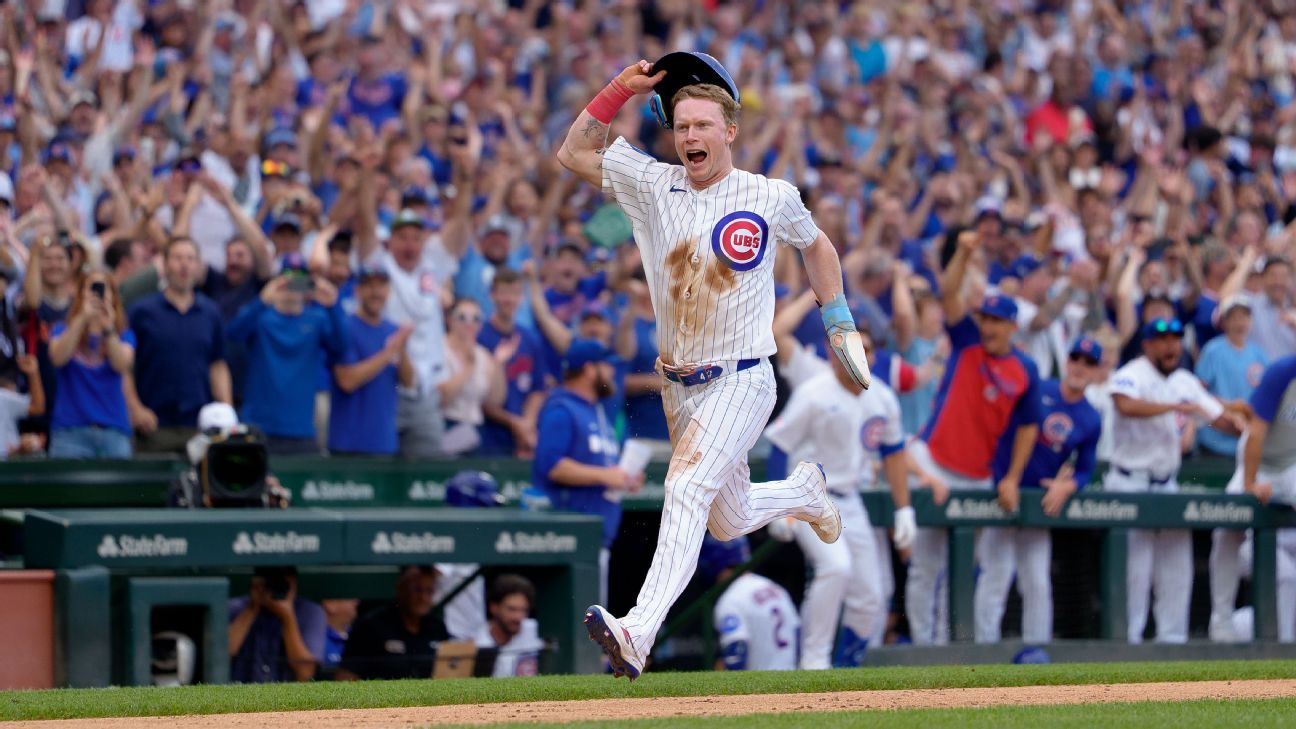
The Chicago Cubs’ star center fielder is not just the National League MVP. He should win the award unanimously. He has been by far the best player in baseball this season, which is saying something in a year in which Shohei Ohtani hit and pitched. What’s most impressive, in fact, is the chasm in production between Crow-Amstrong and every other big leaguer.
Only three times in MLB history has the gap between the player with the most FanGraphs wins above replacement and the second-highest WAR total been as large as it is between Crow-Armstrong and Kansas City shortstop Bobby Witt Jr. this season. Crow-Armstrong is sporting an advantage of 3.6 WAR — 10.2 to 6.6. The other seasons: Babe Ruth over Harry Heilman by 5.7 WAR in 1923, Ruth over Lou Gehrig by 4.8 in 1926, and Mickey Mantle over Duke Snider by 4.0 in 1956.
So, PCA is having the most dominant season, compared with his peers, in seven decades? Well, by one measure, sure. The other major publicly available WAR, Baseball-Reference, has a 1.9-win gap between Crow-Armstrong and Philadelphia ace Cristopher Sánchez — a top-20 difference in the live ball era but by no means the same sort of edge FanGraphs sees.
And that’s fine. Systems can differ in their calculations of value. It doesn’t take anything away from the full PCA experience this season. He leads MLB with 45 home runs. He’s on top in defensive outs above average, too. He’s fifth with 38 stolen bases. He has more than doubled his career walk rate to 11.1%. He has power, defensive chops, speed and patience, and he’s having the sort of season only the game’s most renowned names put up.
One look at 10-win seasons by outfielders in the past half-century illustrates that. Only five players have reached that mark: Barry Bonds five times, Aaron Judge three, Mike Trout two, and Rickey Henderson, Mookie Betts and Crow-Armstrong one time apiece. None went 40/40 like Crow-Armstrong will look to do with two more stolen bases this week. The closest facsimiles are Trout in his first full season (30 home runs and 49 stolen bases) and Betts in 2018 (32 and 30).
Even though Trout and Betts had better all-around offensive numbers, Crow-Armstrong’s acumen at such an important defensive position makes up for whatever offensive deficiencies one chooses to use against him. And given that he has the highest wOBA in the NL this year, Crow-Armstrong’s bat has done sufficient talking already.
The Giant Right-Hander of the Year: Jacob Misiorowski
The two best pitchers in baseball this season are right-handers in their mid-20s who stand at least 6-foot-6 and average at least 98 mph with their four-seam fastballs. Milwaukee’s Jacob Misiorowski and the New York Yankees’ Cam Schlittler are heavy favorites to win the Cy Young Award in their respective leagues, but when compared to one another, it’s not quite as easy as just anointing the Miz.
Let’s start here: Both are true outliers. Misiorowski leaning heavily on his fastball — he throws it 63.3% of the time, more than 10 percentage points higher than any other pitcher qualified for the ERA title — makes complete sense because it is the hardest fastball from any starter ever, averaging 100.5 mph. It’s more than 2.5 mph firmer than the next-hardest heater, Schlittler’s, and he throws it only 44.2% of the time, well above the 30.7% leaguewide average.
Schlittler stands out when you factor in his cutter (25.6%) and sinker (19.5%). He embodies the three-fastball strategy in which a pitcher throws a constant diet of fastball types that run true (four-seamer), in to right-handed hitters (sinker) and away from them (cutter). Boston’s Payton Tolle is perhaps the best comparable for Schlittler, throwing one of his three fastballs 87.7% of the time to Schlittler’s 89.4%.
Perhaps the most impressive of Schlittler’s numbers — and the argument for him ahead of Misiorowski — is innings pitched. It’s a 24⅓-inning gap, and considering how close their other numbers are, it’s entirely fair to believe Schlittler warrants the honor.
Everything is looking good for Schlittler until the slash line allowed. His is tremendous, one of the 20 best for a starting pitcher this century. Plenty worthy of a Cy Young. But it’s nearly 70 OPS points higher than Misiorowski’s. The .250 slugging against Miz is the lowest this century — better than even 2000 Pedro Martinez’s, whose OPS against of .473 was one better than Misiorowski’s.
As much as innings matter, Misiorowski has been so good this year that he makes up for his lack thereof. Dominance is a rarity, and dominance of this caliber warrants celebration — or, at very least, a made-up award.
The AL MVP favorite for practically the entire season has cooled down enough to bring his OPS to 1.027 — and it’s still 230 points higher than that of any other player on the Houston Astros.
By no means does Tampa Bay’s Junior Caminero, the greatest threat to Alvarez’s first MVP award, live in a lineup of boppers. But the Rays’ offense is perfectly solid and plenty sufficient to win the pennant. It also has Yandy Diaz, Jonathan Aranda and Liam Hicks posting full-season .800-plus OPS, with Victor Mesa Jr. doing the same, albeit in fewer at-bats.
Alvarez is alone, with Jeremy Peña (.796) and Isaac Paredes (.792) in the neighborhood. And that’s not enough to keep managers from thinking twice before intentionally walking Alvarez. He’s not getting Barry Bonds treatment quite yet — Alvarez’s 32 intentional walks this season are 88 fewer than Bonds drew in 2004 — but he is already tied for the second most in the AL this century, four behind Aaron Judge last year.
While a little lineup protection for Alvarez would be nice, he continues to so thoroughly dominate his competition in meaningful areas that the MVP conversation rightly goes back to him. After spending months in possession of the AL lead in batting average, home runs and RBIs, the only Triple Crown he can reasonably win is the triple-slash crown.
And that’s telling, because Alvarez’s on-base percentage is 65 points higher than Caminero’s and his slugging percentage 64. As much as anyone wants to argue that Caminero’s defense at third base more than makes up for a 130-point OPS gap … it doesn’t. Maybe he catches fire the final week and Alvarez craters and there’s an 11th-hour flip. As of now, though, the AL MVP is a designated hitter — and one who does much of it by himself.
Baseball’s automated ball-strike challenge system already feels like it’s been around for years, which is a testament to how seamlessly MLB and the players integrated it into the game in its debut this year. ABS rights wrongs, which is its intended goal, but in the process also manages to turn the reviews themselves into meaningful moments. The 10-second window between challenge and result builds tension and sets up moments of glory or grief. Credit where it’s due: Something that could’ve been downright scary — baseball was worried about the robots taking over long before AI doom chatter — wound up putting the fun in functional.
Among the more than 10,000 challenges this year, there’s a special brand that stands out from the others: the <0.1″ review. Because every player has a set strike zone, there are literal lines of demarcation that separate ball from strike. Some pitches are bound to push up against the very edge of such lines. And the closest ones, when shown on the scoreboard, say explicitly they’re less than one-tenth of an inch — that’s around 2 millimeters — from being a strike.
There have been 237 pitches this season classified by TruMedia as being 0.0 inches from the zone. Isaac Paredes laying off a 90 mph slider from Misiorowski. Bryan Reynolds flipping a strikeout to a walk on full-count, 99 mph gas from Luis Mey. Every successful challenge on a pitch that close is simultaneously impressive and lucky.
The best of the bunch, however, belongs to Minnesota Twins outfielder Trevor Larnach. Leading off the fifth inning of a June 24 game against the Dodgers, Larnach stared at a first-pitch curveball from Ohtani that plate umpire Ryan Additon called a strike. With one challenge already burned — the Twins lead MLB in challenges as well as overturns — Larnach was taking a risk, particularly on a pitch so definitionally borderline.
The result? Well, see for yourself.
Trevor Larnach wins an ABS challenge against Shohei Ohtani – and it might be the closest one you’ll ever see.
A razor-thin call.#MNTwins | #Dodgers | #MLB pic.twitter.com/U6iMl1mZyb
— Talkin’ Twins (@TalkinTwins) June 25, 2026
That … kind of looks like a strike! I went through every other 0.0-inch pitch that was challenged, and none of the other overturns had what appears to be a sliver of the ball in the zone. Seeing as how the system’s stated margin of error by MLB is .16 inches — around 4 millimeters — it’s genuinely possible that this was a strike and the robots got it wrong.
Larnach wound up grounding out on the same at-bat, so this wasn’t a challenge that added a whole lot of win probability or turned the game around. It was the simplest sort of awesomeness — a level of strike zone awareness acute to the millimeter. Or, in a less generous view, a really lucky break.
Along with the hundreds of impressive, can’t-slide-a-sheet-of-paper-between-the-ball-and-the-zone challenges, there have been a fair share of stinkers, too. Miami Marlins outfielder Kyle Stowers questioning a Michael McGreevy curveball that was a half-foot inside the zone. Tampa Bay Rays catcher Nick Fortes tapping his head on a 3-2, bases-loaded Tyler Wells changeup that was 7.2 inches above the zone — the largest margin of any bad challenge this year.
The winner of the worst challenge, though, combined an awful miss with situationally unaware body language that makes the whole thing pure cinema. Atlanta catcher Drake Baldwin stood at the plate. The bases were empty. The count was full. Two outs. And with Pittsburgh trailing 6-4, Yohan Ramírez fired a 96.7 mph fastball inside. Ramírez was convinced he’d painted the pitch. He spun off the mound and walked toward the Pirates’ dugout. He was telegraphing what was about to come. The Braves’ announcers baited him with glee.
“C’mon, do it. Yes! No way he just did that! Ball missed by a foot.”
ABS confirmed in #Braves at #Pirates (Top 6).
Yohan Ramírez challenged the ball call on Yohan Ramírez’s pitch to Drake Baldwin.
Ball confirmed.
HP: Nic Lentz | Upheld 56.5% (61/108).
Result: Drake Baldwin walks. pic.twitter.com/3ohT1Sp1Qd— ABS Auditor (@ABS_Auditor) July 9, 2026
It wasn’t quite a foot. But it was 5.5 inches off the plate — about the size of two full baseballs. Ramírez wound up wriggling out of it, but that didn’t change the lesson the moment reinforced: In an environment where catchers are incorrect 41.2% of the time and hitters 51%, do not join the ranks of the 60.7% of pitchers who tap their heads and have only shame to show for it.
Individual Performance of the Year: Jo Adell
This was the winner in our midseason awards. And despite the best efforts of Jacob Misiorowski in his one-hit, 15-strikeout shutout of the Phillies and St. Louis outfielder Joshua Baez with his three-homer major league debut, we’re confident in saying Adell’s performance April 4 will never be seen again in MLB.
It started in the first inning, when Adell timed his leap to rob Seattle’s Cal Raleigh of a home run in right field. Seven innings later, with the Los Angeles Angels clinging to a 1-0 lead, Adell did it again in almost the exact same spot, yanking back a would-be Josh Naylor home run. Both were impressive — every home run robbery is — but compared with what came next, they were pretty basic.
With the score still 1-0 in the ninth, leadoff hitter J.P. Crawford lofted a ball down the right-field line. Adell sprinted toward the corner, where the fence is only 5 feet tall. As he neared the wall, Adell slowed from a dead sprint, extended his left arm over the fence and, after leaping and hitting the fence, tumbled over it. It took a couple of seconds for him to stand up. Adell did so with his left arm extended, glove squeezed, ball inside of it.
All THREE of Jo Adell’s home run robberies from tonight …
Yes, you read that right 😮 pic.twitter.com/axhyQFpLHD
— MLB (@MLB) April 5, 2026
One game, three home run robberies — all from a player whose defense since he got to the big leagues has been rather maligned. While it’s true that Baez became the first big leaguer ever to hit three home runs in his first game, the likelihood of that happening again is a fair bit higher than three home run robberies in any game. There have been 15 three-homer games this season. Over the course of this entire year, only five outfielders have robbed three or more home runs. San Diego center fielder Jackson Merrill leads MLB with five robberies.
Since the magical day, Adell has robbed only one homer — and none since he was traded at the deadline to the Cleveland Guardians. More than anything, thieving a home run is about opportunity — there have been only 29 robberies all year, according to TruMedia — and on April 4, opportunity found Adell.
Nastiest Pitch of the Year: Shohei Ohtani
In terms of its raw characteristics, the sweeper Ohtani threw Jose Altuve on a 1-2 count to end the fifth inning against the Houston Astros on May 5 was rather unique. What it lacked in elite horizontal movement — of the 393 sweepers Ohtani threw this year, 126 had more glove-side action than this one’s 16.6 inches — it made up for in velocity and spin. The pitch screamed toward the plate at 88.8 mph, spinning at 2,967 RPM, and when combined with the movement, Marlins reliever Calvin Faucher is the only pitcher this season who has thrown a pitch that exceeded Ohtani’s in all three metrics.
But this isn’t the nastiest pitch because Stuff+ models like it. Some of the pitches that spit out the best grades look perfectly average to the naked eye. No, Ohtani wins this award more for what the pitch did to Altuve than what it did in time and space.
Look at this swing.
Altuve missed this Shohei Ohtani Sweeper by 2 Altuves. pic.twitter.com/UeMozHShqL
— Rob Friedman (@PitchingNinja) May 6, 2026
For baseball fans who see nastiness as something objective and measurable, that’s great. You do you. Me? I want to see a future Hall of Famer swinging at a pitch more than 2½ feet outside the strike zone.
It was 3.23 feet from the center of the plate, to be exact. The last pass at a pitch that far outside the zone came in 2022, when Bobby Witt Jr. failed to check his swing on a Lou Trivino slider. Altuve did not check his swing. With runners on the corners and two outs, he went after it and made a good pitch look nasty as can be.
The Best Year You Had No Idea Was Happening Award: Jake Bauers
Once upon a time, Jake Bauers was a top-100 prospect. He had reached Double-A at 19 and more than held his own, and even if his power was burgeoning, the Rays had spent years with James Loney and Logan Morrison at first base. He barely stayed over the Mendoza line as a rookie and wound up getting traded in December 2018 to Cleveland, starting a circuitous journey that would take him to Seattle, Cincinnati and the New York Yankees before he turned into one of the best hitters in baseball in Milwaukee.
And as much credit as the Brewers are due … even they once dumped Bauers, outrighting him off the 40-man roster in the winter of 2024 before re-signing him and seeing him, at 30, finally break out.
How? Well, let’s first look at what Bauers is doing.
Weighted on-base average (among all MLB players qualified for the batting title)
1. Yordan Alvarez, .426
2. Pete Crow-Armstrong, .402
3. Willson Contreras, .393
4. Jake Bauers, .389
5. James Wood, .387
6. Shohei Ohtani, .381
On-base percentage
1. Alvarez, .430
2. Bauers, .397
Walk rate
1. Munetaka Murakami, 17.1%
2. Bauers, 16.8%
So it’s clear: Bauers has a very good eye. And he always has. But he is far from a high-on-base, empty-slug guy. Bauers has spent the year hovering around a .500 slugging percentage, ranking among the top 20 in the game, thanks to the combination of a mastery of the strike zone and bat speed among the best in the sport.
While Bauers has long excelled in these areas, the Brewers did what all the other teams before them didn’t: play him. Prior to this season, when he has stepped up to bat more than 550 times, Bauers’ career-best 423 plate appearances came seven years ago. Other teams saw flashes. Just not production.
Milwaukee’s patience paid off. Bauers’ spray chart is a gorgeous array. He’s just as happy to lace a ball down the left-field line as he is to pull one into the right-field corner. He goes to both gaps with real power. On a team with Jackson Chourio, Brice Turang and William Contreras, Bauers is the best bat.
With all due respect to Marlins shortstop Otto Lopez — who, at 27, has turned into an All-Star and is approaching a 6-WAR season — Bauers’ emergence is the best surprise of the season. A .269/.397/.497 slash with 26 homers, 83 RBIs, 90 runs and even 11 stolen bases is quite the season to have as he prepares to reach free agency and cash in as one of the best bats on the market.
The April and May Don’t Count Award: Fernando Tatis Jr. and Jackson Merrill
On June 1, Merrill was 149th of 160 qualified players in wOBA and Tatis 120th. Merrill was batting .209 and slugging .335. Tatis had hit his first home run of the season two days earlier. Together, the two were supposed to be the present and future of the San Diego Padres, with contracts guaranteeing them a combined $475 million, and they were performing like bottom-of-the-roster also-rans.
Since then, Tatis has been the second-best player in baseball and Merrill the do-everything force second only to Crow-Armstrong among center fielders. They have revitalized the Padres, who, in spite of a bottom-half starting rotation, have the best record in MLB since July 23. The Padres have put themselves on the cusp of a postseason berth — and could even host a wild-card series after beginning the month five games back of Chicago and Philadelphia.
And while credit doesn’t go entirely to the duo — Ty France has had a monster season, putting up Bauers-like numbers after three years of substandard offensive production — Tatis and Merrill are doing exactly what they’re supposed to, and it’s why NL teams fear the Padres.
Tatis, 27, looks as good as he has since he hit 42 home runs at 22 years old. He’s up to 25 home runs to complement his 36 stolen bases and remains good in right field and plenty playable at second base, a position at which he’d spent one big league inning until logging 407 this year. Merrill, 23, is similarly dynamic with 26 homers and 26 stolen bases and keeps getting better in center, his home run robberies a testament.
For far too long, San Diego looked lost. Now the Padres, armed with a bullpen to match Milwaukee’s and enough thunder to tag the elite pitching they’ll see in the postseason, have found themselves — and, if Tatis and Merrill keep it up, could find their way through a perilous NL playoff bracket.
This could’ve been the New York Mets, but considering the excellent rookie seasons turned in by Carson Benge and A.J. Ewing — who very easily could combine with Juan Soto to form the best outfield in baseball as soon as next season — at least the Mets have something positive to say about 2026.
In Seattle, almost everyone on the roster has gone backward. It’s easy to target Cal Raleigh not hitting half as many home runs as he did last year or Julio Rodriguez turning into a pumpkin in the second half. But this is about the starting pitching, long the Mariners’ strength, posting an ERA over 4.00 for the first time since before they made the postseason in 2022. And it’s about a bullpen that absolutely cratered following years of consistent performance.
Mariners relievers’ ERA by year (MLB rank in parentheses)
2022: 3.33 (6th)
2023: 3.48 (4th)
2024: 3.71 (9th)
2025: 3.72 (9th)
2026: 4.51 (23rd)
It’s about Josh Naylor signing for $92.5 million and not even being a league-average offensive player in his first year, and it’s about Brendan Donovan arriving as a super-utility solution to potential holes and spending three-quarters of the season on the injured list. Even when it’s going well, it really kind of isn’t: Outfielder Randy Arozarena has been the best player on the team by a good margin … only to reach free agency this winter and very likely spend next season in a different uniform.
Sometimes in baseball, a team comes together and just doesn’t work. That is the 2026 Mariners. Even as Dominic Canzone and Cole Young blossomed, even as Colt Emerson and Kade Anderson and Laz Montes arrived, so much around them failed. There were a lot of “tough ones.”
That is a favorite phrase of Seattle manager Dan Wilson, who has used the word so often to describe losses that one particularly masochistic Mariners fan started a website to chronicle them called www.toughonetonight.com. Wilson is not expected back, and most of Seattle’s core is, which will make 2027 the most urgent season yet for a franchise going on a half-century of existence without a World Series.
The Mariners still have the talent to be great. They just decidedly weren’t in 2026.
Transaction of the Year: Alex Bregman
The tortuous post-Astros journey of Bregman was a late-career extension of what always fueled him: doubt. In his early years, coaches and evaluators doubted his ability to compete against the best players because of his height (now an ABS-certified 5-foot-10) and relative lack of bat speed. Then he went out, won a couple of World Series, nearly got an MVP and became among the most beloved Astros.
Owner Jim Crane didn’t see that as enough to deviate from his rule — no free agent deals longer than five years — and so Bregman sought that on the free agent market … only for it to never come. They doubted how he’d age. They doubted the numbers that came on a team that cheated for one of those World Series. And so while Boston was happy to give him $40 million a year, it was for just three years.
Bregman opted out of that deal, and while the market was kinder, the industry thought the Cubs wildly overpaid when they gave him five years and $175 million over the winter. Even if the $70 million in deferred money took the value of the deal closer to $132 million, Bregman was 32 and, many believed, past his prime. And for the season’s first four months, they weren’t wrong.
Where Bregman excels most is not necessarily on the field, though. It’s tearing through video. It’s working on his swing. It’s putting in the requisite time to get himself right. The breakthrough finally happened in August, and in the time since, Bregman has been the second-best player in baseball behind his teammate Crow-Armstrong. The power is back. The strikeouts are practically nonexistent. His season OPS, at .689 entering August, is now over .800. And thanks to the tweaks he made at the plate, it’s the sort of thing Bregman can replicate and continue.
So keep doubting. People always have and will with Bregman. And, as always, he’s intent on taking the questions and letting them power the engine that looks as good as it has in years.
A few runners-up:
-
The dual St. Louis-to-Boston trades of Sonny Gray and Willson Contreras in which the Cardinals cleaned up, too, getting dynamic arms in 102 mph-slinging lefty Brandon Clarke and 19-year-old right-hander Yhoiker Fajardo, who’s already at Double-A.
-
The Toronto Blue Jays getting Cy Young-caliber production from Dylan Cease after giving him a seven-year, $210 million contract. Much like the Cy Young Award, Cease was perhaps at the top of this category until a couple of down September performances followed by the revelation of a shoulder injury.
-
The Chicago White Sox’s deal with Munetaka Murakami was the runaway favorite until a late-May hamstring strain and 38.6% strikeout rate since.
-
Pete Alonso and Kyle Schwarber signed almost-identical deals and have been equally awesome for the Orioles and Phillies.
-
One-year wonders: Nick Martinez with the Rays ($13 million), Luis Arraez with the Giants ($12 million), Foster Griffin with the Nationals ($5.5 million), Ty France with the Padres ($4.5 million) and Taylor Clarke with the Diamondbacks ($1.5 million)