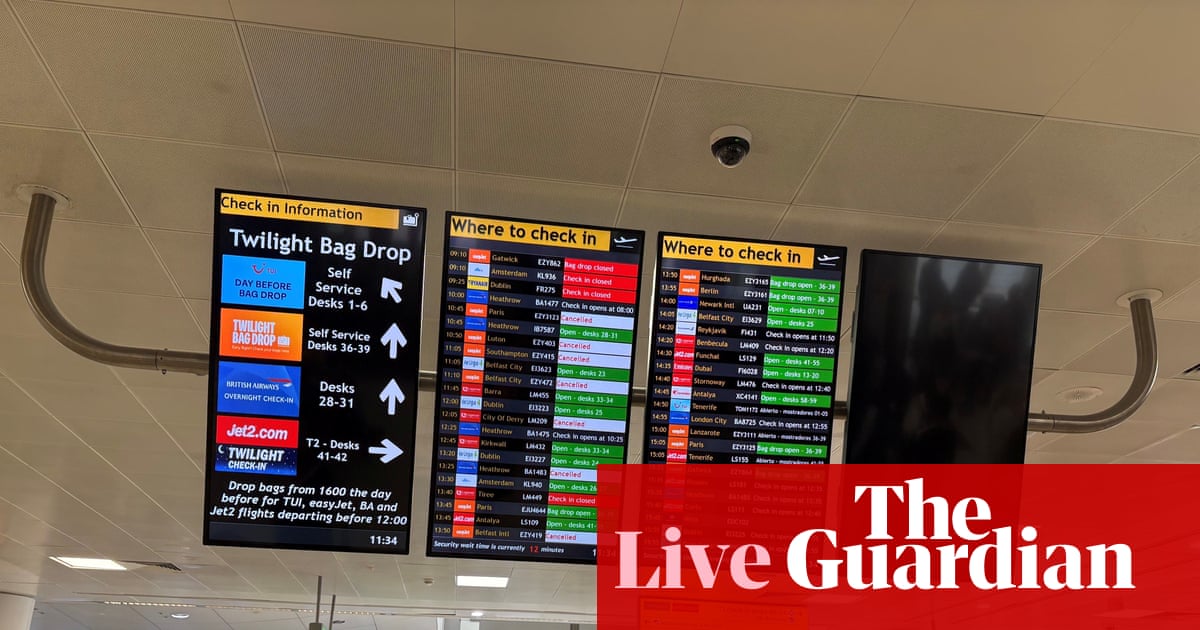
Air traffic control failure disrupts flights in Scotland, Northern Ireland and northern England
UPDATE: ‘Technical issue’ has been fixed, according to UK transport secretary. An air traffic control failure has disrupted flights in parts of the UK, about two weeks after a software glitch caused widespread flight chaos in the UK.
A number of departing and arriving flights at Scottish airports have been severely delayed, with disruption affecting Scotland, Northern Ireland and northern England.
The technical fault has been reported at National Air Traffic Services (Nats)’ second control centre, at Prestwick in Scotland.
NATS said the issue is unrelated to the problems earlier this month, when more than 2,000 flights were cancelled to and from the UK due to a NATS software glitch, disrupting travel plans for hundreds of thousands of passengers.
Some flights at Manchester Airport are delayed as a result this morning. EasyJet and British Airways issued messages to passengers that they may face delays.
In a statement, a Nats spokesperson said:
We are investigating a technical issue at our Prestwick centre in Scotland. To maintain safety, air traffic regulations have been applied to manage traffic demand.
Engineers are on site investigating and working to resolve the issue. The issue is unrelated to the technical problems experienced earlier this month.
We apologise for the disruption and any delays to passengers’ journeys. Passengers should check with their airline for the latest information on their flight.
Key events
The ABTA, the trade association for UK travel agents, tour operators and the wider travel industry, has expressed its frustration about the latest travel disruption caused by an air traffic control failure.
It asked the government to consider whether National Air Traffic Services, which is partly state-owned, “should be made to compensate the wider industry for such events”.
Luke Petherbridge, ABTA’s director of public affairs, said:
This is the second Nats incident to cause disruption in the last fortnight, and fourth in recent years. It’s simply not good enough. The industry and travelling public will want answers – not only on what has gone wrong, but critically how the system is going to be made more resilient to avoid future outages.
These incidents cause inconvenience to travellers and significant financial costs for airlines and the wider travel industry, including additional work and costs for ABTA’s tour operator and travel agent members.
As these Nats issues are entirely outside of travel companies’ control, the government should seriously consider whether Nats should be made to compensate the wider industry for such events.
Fears over interest rate rise and jobs send UK consumer confidence to three-year low
Fears of a steep rise in mortgage payments and increasing job insecurity have sent UK consumer confidence tumbling to a three-month low, according to a leading survey.
In a blow to John Healey before next month’s budget, the S&P Global consumer sentiment index dropped to 42.7 in September from 42.9 in August, indicating “a notable strain on financial confidence across UK households”.
The chancellor could announce tax rises in his first budget to offset the rising cost of government borrowing, which has soared in response to the conflict in the Middle East.
S&P Global said consumers were concerned about the likelihood of an increase in interest rates by the Bank of England. More than 50% of 1,500 respondents said they expected a rise in the cost of borrowing over the next year.
Fixed-rate mortgage costs have already jumped to multi-year highs in the UK, while the threat of artificial intelligence and caution among employers about hiring new staff sent consumer confidence in the jobs market plunging to its lowest level in three-and-a-half years.
The average two-year fixed residential mortgage rate rose to 5.88% on Monday, its highest since 16 April and up from 5.84% last Friday, while the average five-year is at its highest since October 2023, at 5.92%, up from 5.88%, data from Moneyfacts showed.
The rise in mortgage costs is expected to add about £150 to monthly mortgage payments, based on a typical loan of £250,000 over 25 years, since the start of March 2026.
Official figures have shown that the average direct debit to cover monthly mortgage costs has risen over the past four years from about £600 to £900.
Maryam Baluch, an economist at S&P Global Market Intelligence, said a downbeat mood was spreading across UK households
as improved sentiment surrounding the new government is eroded by renewed worries over energy prices, the cost of living and job prospects.
Against a backdrop of rising volatility in energy markets linked to tensions in the Middle East, households increasingly reported difficulties accessing credit, suggesting that expectations of tighter monetary conditions are beginning to feed through to borrowing conditions. Together, these factors point to cautiousness about both financial prospects and pose some downside risks to the broader economic outlook.
Scottish first minister says Nats flight disruption is ‘very regrettable’
Disruption caused by an issue with air traffic control systems is “very regrettable”, Scottish first minister John Swinney has said.
Speaking to the Press Association during an unrelated visit to Edinburgh airport, the first minister said:
It’s very regrettable that there’s been an issue with the air traffic control system today and that members of the public have experienced disruption as a result.
I’m glad the issues are now resolved and that flights are able to take their normal course, but it demonstrates of all organisations, particularly the air traffic control system, having resilience, being able to withstand issues in the systems, so that people can rely on the services that are being provided.
So, we’ll engage with the national air traffic control service to ensure that these issues are addressed and that the resilience is necessary for these systems is available at all times.
Here are a couple of pics from affected airports.

Aletha Adu
On the air traffic control issue in parts of the UK, the prime minister’s spokesperson acknowledged that it is “deeply frustrating” for passengers, reports our political correspondent Aletha Adu.
There’s a review that is ongoing, and the transport secretary has been clear that we need to urgently understand why the issue wasn’t discovered and fixed before it caused chaos.
Engineers have fixed the problem, and systems are resuming. But we recognise this is deeply frustrating for passengers, particularly after a recent incident, and it’s crucial that our national infrastructure is fit for purpose now and in the future. And we’ll make sure the aviation sector is as resilient as possible, so passengers can get to where they need to be.
Here’s a round-up of our main stories today:
Airbus to hire up to 900 workers in north Wales
Alex Daniel
Airbus is expected to hire as many as 900 more workers in north Wales to build its long-range A321 jet, as the aircraft maker invests £150m to ramp up jet production.
The company has a backlog of more than 5,000 of the planes, and will make an initial 480 new hires at its wing production centre in Broughton to help meet soaring demand.
Airbus is understood to be planning a similar number of hires next year at the group of factories, which have about 6,000 people working there.
The move will include restarting production at its West Factory, which used to make the wings for its double-decker A380 jet, but was converted into a warehouse after the company made 1,700 people redundant across its UK sites during the pandemic.
The West Factory will be retooled to build the new aircraft which can fly 240 passengers from the UK to the east coast of the US.
Jerome Blandin, head of Airbus Wing, said:
Investing in our capacity strengthens our industrial footprint, creates high value jobs that support the wider UK aerospace sector and ensures we remain competitive in the years to come.
The investment comes after Airbus said it would also expand a wing factory in Belfast over the next few years to help it build more of its smaller A220 planes.
UK car industry warns locking UK out of ‘Made in Europe’ would be ‘own goal’

Lisa O’Carroll
Locking the UK out of a new EU scheme to protect industries from Chinese competition would be an “own goal” and risk up to 250,000 jobs in the bloc, the British car industry has warned.
Most of those jobs, 69,000, would be jeopardised in Germany, France and Spain but also in central and Eastern Europe, according to a new study by Oxford Economics commissioned by the Society of Motor Manufacturers and Traders (SMMT).
SMMT’s arguments comes days after the chancellor, John Healy, urged EU finance ministers to include the UK in its definition of Made in Europe legislation.
They fear if UK industry is locked out then EU manufacturers may no longer buy British parts for assembly lines.
The government is also warning that it won’t commit to a second EU-UK summit unless Made in Europe is discussed amid fears over opposition in France to including Britain and other countries such as Japan who are warning that their EU bases should be included.
Mike Hawes, head of SMMT, said:
The EU is rightly focused on strengthening its industrial base, but the UK remains fundamental to Europe’s automotive ecosystem and is therefore essential to that ambition. Excluding the UK from ‘Made in Europe’ would be an own goal, weakening competitiveness, reducing scale and limiting consumer choice.
Ryanair calls on Nats CEO to ‘resign immediately’ or be sacked
Ryanair has stepped up calls on the Nats chief executive Martin Rolfe to resign immediately, or for transport secretary Heidi Alexander to sack him.
This latest Nats failure which is affecting its Prestwick control centre is disrupting flights operating to and from Dublin, Edinburgh, Newcastle, Manchester and a range of airports across Scotland, Northern England, and Ireland.
So far, more than 25,000 Ryanair passengers are expected to be affected, with more than 140 Ryanair flights delayed and delays exceeding three hours.
This latest system failure comes just days after Nats published its preliminary report into the 8 September failure.
Ryanair said:
Today’s disruption raises serious questions about Nats’ operational resilience and why, after repeated system failures, there is still no effective back-up system capable of preventing widespread passenger disruption.
The report confirmed that the permanent software fix identified following the 8 September failure had not yet been implemented and remained under testing.
Ryanair’s chief operations officer, Neal McMahon, said:
Just three days after NATS assured airlines and passengers that it had introduced a robust ‘mitigation plans’, its flight data processing system has failed again. More than 25,000 Ryanair passengers have already suffered disruption, with over 140 Ryanair flights delayed, yet NATS still cannot tell passengers when this disruption will end.
Martin Rolfe’s report claimed that another failure was ‘unlikely’ and that NATS could recover more quickly if one occurred. Those claims have been exposed as completely worthless. Just three days later, passengers are once again suffering lengthy delays because Nats has failed to deliver either a reliable system or an effective back-up.
After the August 2023 collapse, Martin Rolfe assured parliament that it was a ‘once-in-a-lifetime event’. Then Nats collapsed again on 8 September, disrupting more than 2,000 flights. Now, just 13 days later, the same flight data processing system has failed once more. How many times must UK passengers suffer disruption before Martin Rolfe is replaced by somebody competent?
Another review, another report and another round of empty promises will not fix NATS. Martin Rolfe has presided over repeated system failures, repeated passenger disruption and repeated failures to deliver an effective back-up system. Enough is enough.
Martin Rolfe should resign today. If he will not, then Transport Secretary Heidi Alexander should fire him and appoint somebody capable of delivering the resilient ATC service that UK passengers and airlines deserve.
Here’s our full story on the flight cancellations and delays in parts of the UK, caused by a technical issue at National Air Traffic Services (Nats)’ second control centre, at Prestwick in Scotland.
It’s the second time within a fortnight that a technical problem in air traffic control has disrupted flights, although this time the impact on passengers appears to be more limited. The issue has been fixed, according to the UK’s transport secretary, Heidi Alexander.
Bitcoin soars through $80,000 to seven-month high
Bitcoin has jumped through $80,000 today, hitting the highest levels since May.
The world’s best-known cryptocurrency hit $84,721 this morning.
Chris Beauchamp, chief market analyst at investing and trading platform IG, said:
It has been months since bitcoin has seen the world above $80,000, but it has finally managed to breach the May highs in early trading today. Financial markets have rediscovered a risk-on frame of mind after being consumed with worry about government bond yields, debt piles and the prospect of a return to tighter policy at the world’s most powerful central bank.
Cryptocurrencies are advancing in a group this morning, a move given strength by recent inflows and one likely to attract even more of those vital funds. Perhaps investors are realising that they can live in a world of higher US [interest] rates, though falling oil prices certainly help too.