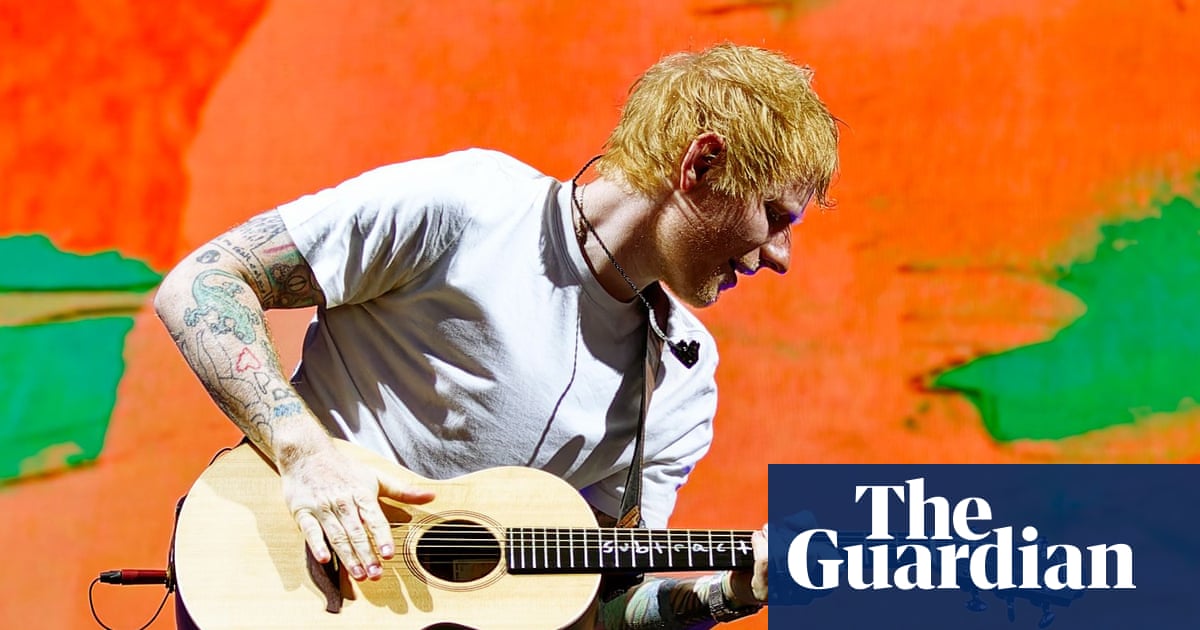
Ed Sheeran has long been known as the “Mr Nice Guy” of music. His is an unthreatening kind of pop stardom; he looks and talks like the bloke who might be standing behind you in a pub, rather than someone selling out stadiums. He champions other artists, he celebrates different cultures. His songs are about love, heartbreak and friendship. People get engaged at his concerts.
But this week, one of the most successful musicians in the world faced the biggest controversy of his career, and found himself dragged into exactly the kind of political row he has spent his career avoiding.
It began when Macklemore, the Grammy-winning rapper supporting Sheeran on the US leg of his Loop tour, used his set at MetLife Stadium in New Jersey to call for a “free Palestine”. He performed Hind’s Hall, his 2024 protest song for a five-year-old girl killed by Israeli forces, while footage of pro-Palestine student demonstrations and destruction in Gaza played behind him.
The backlash was immediate. The StopAntisemitism group accused Macklemore of “ambushing” fans with “anti-Israel propaganda”, a post amplified by the singer Pink. The Israeli-American Council called for him to be pulled from the tour, asking where the line should be drawn “when an opening act uses a global concert platform to advance a one-sided political agenda”. There was extra heat given Macklemore’s history: in 2014 he performed in a fake beard, wig and prosthetic nose widely read as a Jewish caricature. He was soon dropped from the remaining tour dates.
But then Macklemore turned the story on Sheeran, accusing his friend of a “determination not to take sides publicly”, and claiming Robert Kraft – owner of the New England Patriots – had pressured Sheeran by threatening to pull his stadium from the tour dates and urging other venues to do the same. Sheeran’s team confirmed multiple venues had objected to Macklemore staying on the bill. Kraft, a prominent supporter of Israel and founder of the Foundation to Combat Antisemitism, has a personal relationship with Sheeran, who sang at his 2022 wedding. In a phone call with Sheeran, the billionaire reportedly acknowledged the sensitivity of Gaza but argued Macklemore’s remarks crossed into hate speech.
“Taking a side can cost you,” Macklemore said. “Money, brand deals, sponsorships, festivals, private shows, relationships and access. I’ve lost all of those things. But there is no neutral position between the oppressor and the oppressed.”
Sheeran’s own statement, published a day later, did little to calm things. He said dropping Macklemore was not his decision and he was “deeply disappointed” by it, but made clear he was not using the moment to declare a position on Israel and Palestine.
He was “appalled by the conflict”, he wrote, adding that the “suffering and pain caused on both sides” was “a human tragedy”. “I am not complicit. Just because I choose not to speak publicly, it doesn’t mean I don’t have [personal views], and it doesn’t mean that I don’t care.” He wanted his concerts to stay places of “safety and sanctuary”, where people could gather regardless of politics.
The Palestinian Campaign for the Academic and Cultural Boycott of Israel (PACBI) was unconvinced: Sheeran’s statement, it said, “attempts to ‘both-sides’ Israel’s ongoing genocide against Palestinians in Gaza” and its appeal to “peace” left out “its crucial condition – justice”.
“The stakes for him would have been very, very high,” said Dorian Lynskey, the author of 33 Revolutions Per Minute: A History of Protest Songs. “Taking a stand meant potentially cancelling the rest of your tour, with all the refunds, people who work on the tour losing their work. It’s an enormous thing.”
Lynskey, who has interviewed Sheeran several times, has “a lot of sympathy” for him, but he thinks the attempt to frame the decision as something that simply happened around him, rather than a choice he made, has backfired. “He may end up being put in another position which is further away from where his sympathies lie. He’s now being seen as a supporter of genocide, when he obviously isn’t.”
Within days, every other support act on the US tour pulled out, including Finneas, Lukas Graham, the Irish band Beoga and Aaron Rowe. Sheeran’s Instagram following dropped by almost 150,000 in 24 hours; Macklemore gained more than 750,000. The actor Hannah Einbinder, Irish musician CMAT and Zara Larsson spoke up for Macklemore. Then Tommy Robinson tweeted his support for Sheeran, yanking the singer into a political camp about as far as possible from where he would want to be.
Suddenly, one rapper’s decision to speak from a concert stage had ballooned into a full-blown culture war. Many were asking: how does a man who has built a fortune on being liked by everyone end up here?
Subtly progressive
The answer partly lies in the distinction Sheeran has always drawn between having political views and making them part of his public identity. He has never been entirely apolitical. In 2017, he said he was supporting Jeremy Corbyn at the general election, while also saying he did not want to tell other people how to vote. He has campaigned on music education and copyright and supported charities including Crisis. In 2022, he performed at the Concert for Ukraine alongside other artists, raising more than £13.4m for humanitarian relief after Russia’s invasion.
Paloma Faith, who also played at the Concert for Ukraine, highlighted what she perceived as a hypocrisy. “He wasn’t apolitical by doing that and I don’t really understand why one felt more political than the other,” she told Channel 4 News.
The difference, said Lynskey, is that Ukraine reads in the west as a “consensus position” – “like Chris Martin wearing the pride flag, subtly progressive without risk of a massive backlash. That’s the realm Sheeran exists in: generally on the right side of things without talking about them too much. This time he’ll have had people around him going ‘this is how much money you lose’ or ‘this is how you could be tarred as antisemitic’.”
Musicians speaking out is nothing new, from Dylan and civil rights to punk and anti-apartheid – and neither is the price of doing so. In 2003, the Dixie Chicks faced boycotts, radio bans and death threats after Natalie Maines criticised George W Bush over Iraq. What sets Sheeran apart is that he did not say the controversial thing himself – someone he chose to put on his stage did. Choosing Macklemore was not the same as endorsing everything he says. But Macklemore’s politics are not incidental to who he is.
“He can’t say: ‘I didn’t know Macklemore was going to do that’,” said Billy Bragg, who has spent decades making explicitly political music. “Macklemore has been speaking out about Palestine and the war in Gaza for quite some time now. His song Hind’s Hall and its accompanying video are a central aspect of his set. Ed’s people must have seen that on every other night of the tour.”
Stephen Millar, the author of Sounding Dissent, calls it “a maelstrom partly of Sheeran’s own making”. Sheeran had chosen an artist whose politics were well established, he said. “By doing that you could say that was his effort to the cause. But to pull that back is almost like wanting your cake and eating it.”
David Hesmondhalgh, a professor of media, music and culture at the University of Leeds, said while artists should not be compelled to take a position on everything, “Sheeran arguably gains credibility from associating himself with an act like Macklemore whose star persona is based on strong political commitments … So his declarations of neutrality look a bit spineless”.
‘A real S-storm’
The episode also points to a broader shift in what people expect of celebrities. Social media and the sheer weight of feeling over Gaza have made the old split between public image and private politics much harder to hold. “If you’re not using your platform, you’re seen as doing something wrong,” Millar said.
At the same time, artists have become proxies for arguments much bigger than themselves. Lynskey pointed to figures such as Gal Gadot and Mark Ruffalo, who have become stand-ins for opposing sides of the Israel-Palestine debate. “There is this sort of proxy war fought out with celebrities. People have been protesting for almost three years and it doesn’t seem to have made any difference, so I think they’re getting more and more angry and frustrated.”
The journalist Lulu Garcia-Navarro made a similar point to CNN: “There’s an increasing antipathy towards Israel, regardless of left or right, and popular culture gives people a way in – they’re not talking about what’s happening in Congress, but this they can understand.” She pointed to a second layer, too: “Both the left and right feel like they don’t have control over their free speech … today there’s a perception that pro-Palestinian voices get censored. So it’s become a real S-storm.”
Lisa Nandy, the UK culture secretary, said she had “enormous sympathy” for Sheeran, calling his position “really difficult and impossible” – he wanted to platform his support acts, she said, while promoters were warning himthey would cancel shows over politics on stage.
Bragg also acknowledged the practical realities. “Undoubtedly Ed has contractual obligations, and he’d get sued and it would cost him money,” he said. “I can understand it.” But he believes Sheeran could have drawn a cleaner line between defending Macklemore’s right to speak and endorsing every word of it.
“He doesn’t have to come out and say ‘free Palestine’. Put purely on the grounds of free speech, he can say an artist must be able to express their view. He needs to let people know how he feels about billionaires deciding what can and can’t be said from a stage,” he said.
“Of course, someone like Kanye West should be banned because of the antisemitic things he’s said. But drawing attention to the suffering of civilians in Gaza is not a reason to lose your gig. Culture has to entertain, but it can also challenge.”
The point found an echo on the American left. “When you see what Robert Kraft did, to line up all of the stadiums to censor speech in that one specific way, it’s become clear this isn’t about one or two music artists – it’s about how a handful of stadium owners and the elite can bury an entire massive issue. In this case, the genocide in Gaza,” Alexandria Ocasio-Cortez told TMZ. “We need to be very clear about how dangerous a precedent this is.”
Lynskey worries about the wider lesson. “Are you just going to vet your support act for politics? Is the lesson that big artists learn that you don’t book anybody who might be a bit spicy? That would be terrible.”
Taking a stand
Sheeran is due back onstage at Philadelphia’s Lincoln Financial Field on Saturday – with no support acts and no band. “I can’t think of a clear precedent where a star of that size has been put in that kind of situation because of support acts,” Lynskey said. It’s a sharp contrast to his last tour, one of the best-attended of all time; this time thousands of tickets sit unsold, some going for $65 online. Classic Hits Radio in Ireland has dropped him from its playlist “for the foreseeable future”, citing listener reaction.
“In Ireland, rebel songs were used to resist against British occupation for centuries, so the fact that Sheeran makes so much of his Irishness makes his stance all the more jarring,” Millar said.
Sheeran has tried to answer the controversy on his own terms: through money instead of words. Macklemore has pledged $1m of his Loop tour earnings to humanitarian organisations in Gaza; Sheeran and Kraft have each promised $2m for “aid in the region”. It is a way of showing he cares about the human cost without making any overt political statements – but whether it satisfies the people who wanted him to speak is another matter.
Paul Rieckhoff, the founder of Independent Veterans of America, who was inside MetLife Stadium with his two young children on the night of Macklemore’s statement, told CNN Sheeran might be better placed than most to do some good here: “Maybe Ed Sheeran is the person who can actually bring people together around this. But it’s not going to be by throwing Macklemore under the bus or by appeasing Bob Kraft.”
Bragg said: “By trying to be Mr Nice Guy and not take sides, he’s in danger of becoming a pariah himself. And that would be a shame, because it’s not his fault. He does need to make a choice here, and it’s one I think that will define him in the eyes of the public for a long time.”